
E-commerce Price Optimization & Intelligence Features
From tracking a single competitor link to automatically repricing an entire catalog — one dashboard, no spreadsheets.
Accuracy you can trust
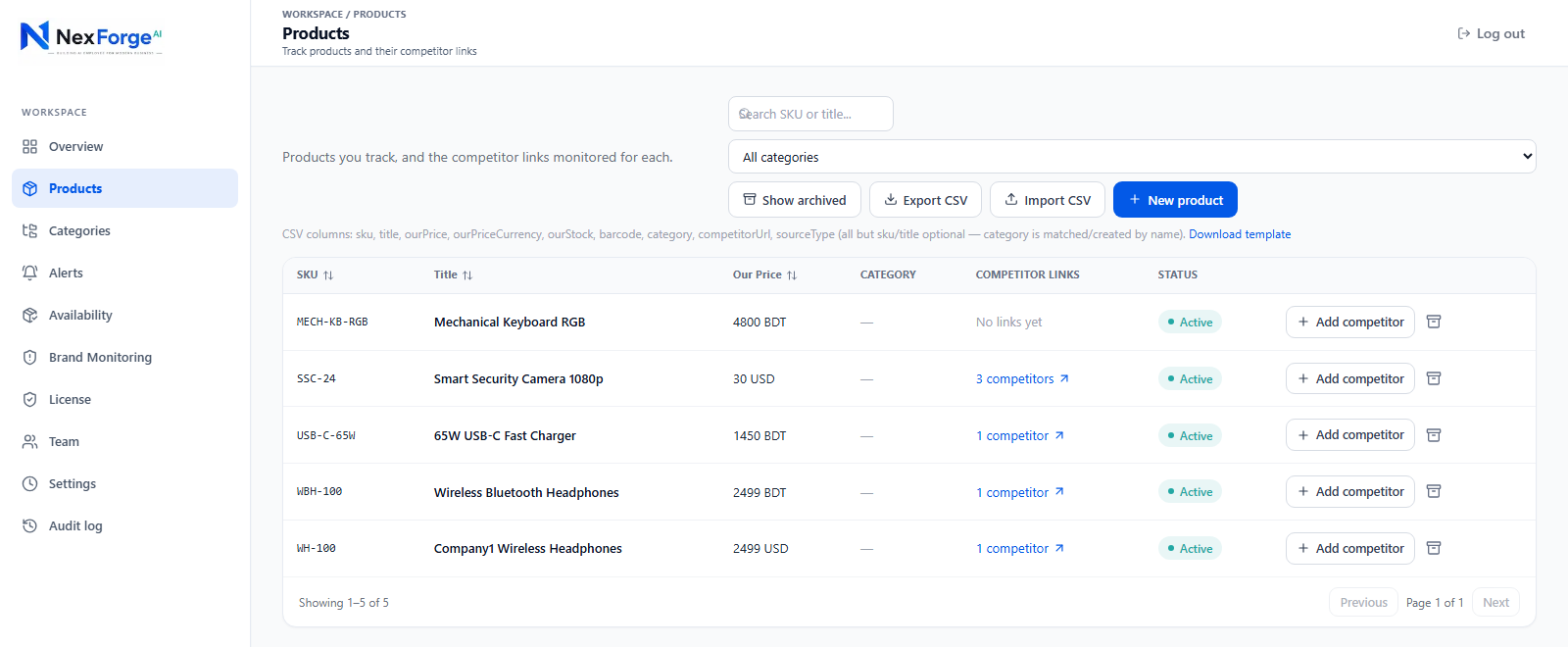
The single most common complaint about competitor-monitoring tools is that the data quietly stops being right — a feed breaks, a check fails silently, and you find out only after pricing against stale numbers for weeks. MarketPulse fights that at more than one layer instead of hoping a single data-collection method keeps working forever.
- Real browser-based data collection (not a plain HTTP request) for JavaScript-heavy sites that render prices dynamically
- Automatic fallback to a dedicated data-collection service for the small number of sites hard enough to need it
- Every competitor link shows its last successful check and any consecutive failures right on the Products page — a failing feed is visible immediately, not discovered weeks later
Advanced Competitor Price Tracking & Stock Tracking Features
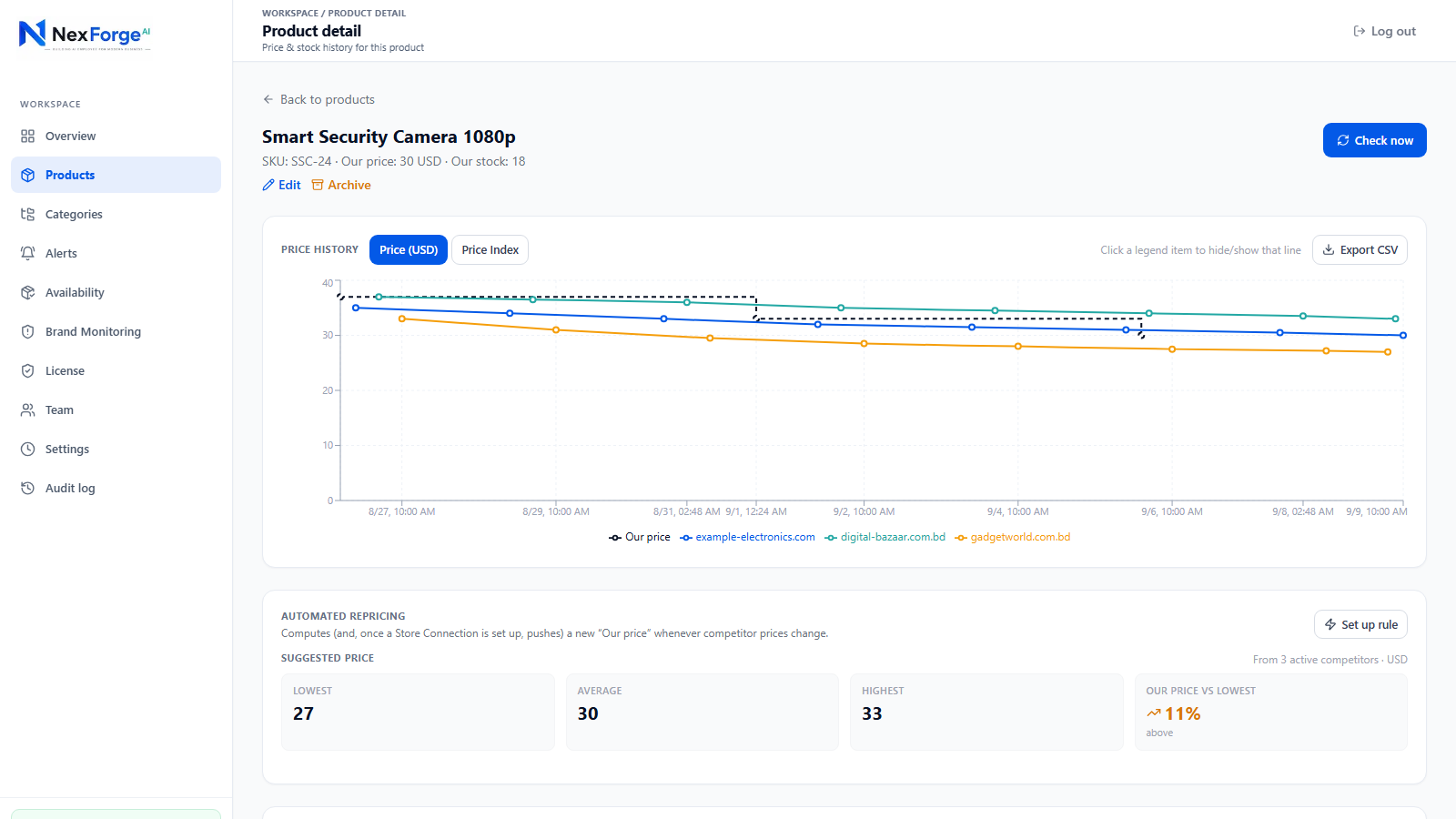
Add a product once, attach every competitor URL you care about, and MarketPulse checks each one on a schedule you control. It reads Shopify and WooCommerce directly, calls Amazon's own API, and falls back to a headless browser for JavaScript-heavy sites that block plain requests.
- Price, stock, and review rating/count history for every competitor link
- Seller name and shipping cost/delivery time, captured whenever a competitor’s page publishes it
- Barcode-based Product Matching — auto-discover listings instead of pasting URLs by hand
- CSV import/export for bulk catalog setup
- Connect WooCommerce via its official OAuth flow — no copying and pasting API keys by hand
Your own custom fields
Price and stock aren't always the whole story. Define a CSS selector for anything else a competitor's page shows — pack size, a cart-only discount, a shelf price — and MarketPulse extracts it on the same schedule as everything else, no separate tool needed.
- Any label you choose, per competitor link — configured from the same Edit screen you already use
- A new value is only recorded when it actually changes, not re-logged on every check
Categories & bulk rules
Group products into categories for cleaner reporting and to apply one strategy across an entire product line at once, instead of configuring each item individually.
- Per-category Market Position rollups
- One repricing rule applied to every product in a category
Automated Repricing Software to Safeguard E-commerce Margins
Set a rule once — match the lowest competitor, beat the average by a fixed amount or percentage, or hold at the ceiling — and MarketPulse computes the right price every cycle. A hard floor price is required on every rule, so automation can never price below what you're willing to sell for.
- Match / beat lowest, average or highest competitor price
- Fixed-amount or percentage offsets
- Correctly reprices products with variants (size, color, etc.) as well as standalone listings — no separate setup needed
- Never proposes a price below your break-even once you set a fee profile (commission, COD, returns)
- Optional stock-out rule: when every competitor you watch is out of stock, raise to your ceiling or by a percentage — back to normal as soon as one returns
- Stores we cannot write to get a Price Suggestions list instead of a lost price change
- Full log of every price change the engine proposed and whether it was pushed live
Alerts that reach you
Price drops, price increases, stock-outs and MAP violations are pushed to Telegram or WhatsApp the moment they happen — set-and-forget, no need to keep the dashboard open.
- Telegram, WhatsApp or a generic webhook for your own automation
- Per-product alert rules with your own threshold
- Optional daily or weekly email digest instead of individual pings, so a busy day never floods your inbox — it also lists the price changes waiting for you
- Choose English or Bengali (বাংলা) for your alerts, alert emails, digests and AI insights — one setting for your whole company
Brand & MAP Monitoring Tools for E-commerce Sellers
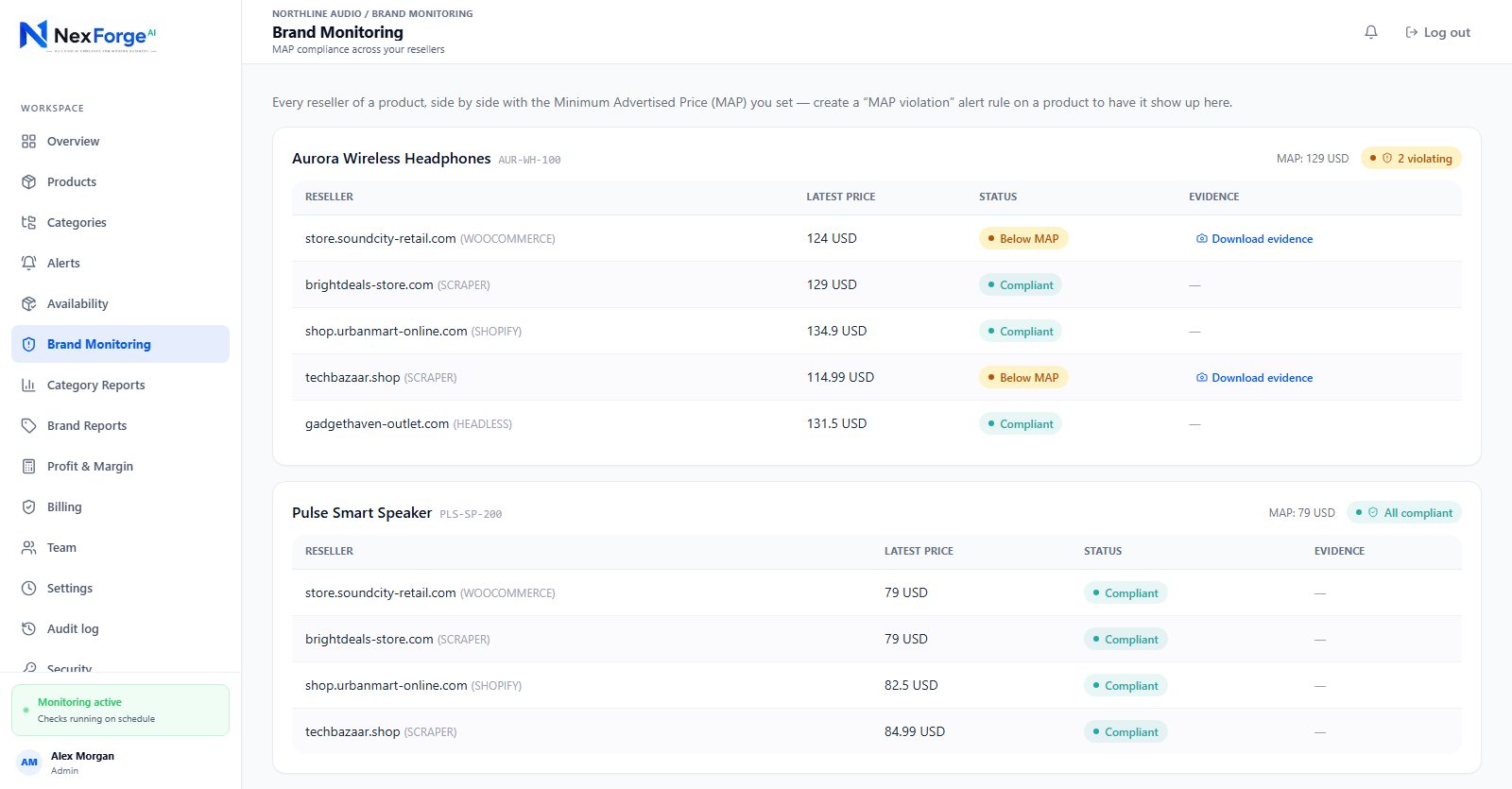
Catch resellers pricing below your minimum advertised price before it erodes trust in your brand across the channels you don't directly control.
- Ongoing visibility into where and how your brand is being resold
- Seller name captured when a marketplace listing publishes it — know which reseller is undercutting you, not just that someone is
- Alerted the moment a MAP violation appears
Market position & reporting
Compare competitor prices against yours at a glance — company-wide and broken down by category — so pricing decisions are based on the actual market, not guesswork.
- Price Index and Market Position across your whole catalog
- Per-category breakdowns
Profit & Margin Calculator
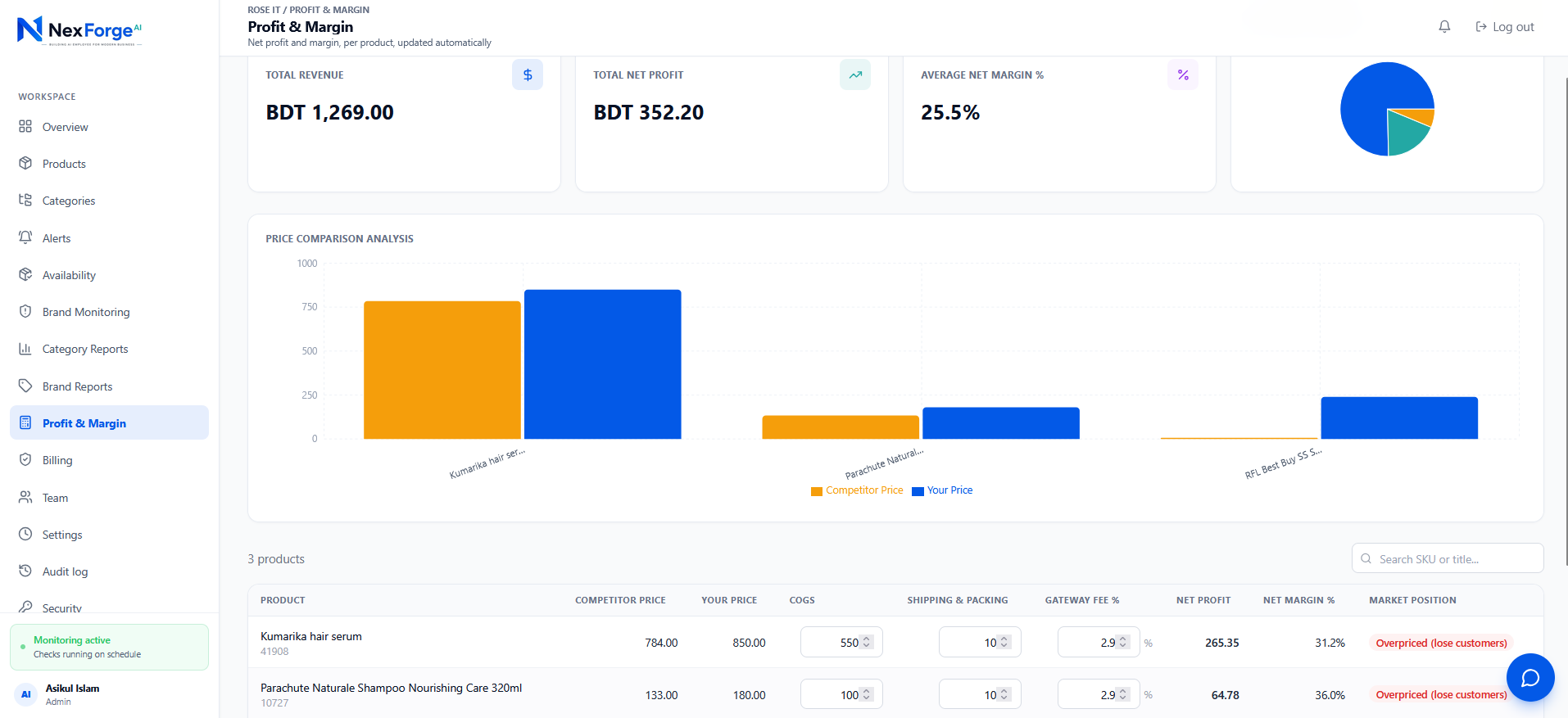
Competitor Price and Your Price update automatically from data you already track — the only inputs entered by hand are the three costs nothing can scrape: COGS, shipping & packing, and your payment/marketplace gateway fee. Edit any of them inline and net profit, net margin and an Optimized/Overpriced call recompute immediately, per product. You can also try our free profit margin calculator to instantly test custom product pricing strategies.
- Net profit and margin computed from your own real tracked data, not a static spreadsheet snapshot
- A company-wide default gateway fee %, with a per-product override for a channel that charges differently
- Search and pagination keep the table usable even with a large catalog
- Add your commission, COD and return costs and the table gains true-profit and break-even columns — see below
True profit — commission, COD and returns included
A price that looks fine can still lose money once marketplace commission, cash-on-delivery fees and the shipping burnt on failed or returned orders are counted. Enter those costs once — as company-wide defaults with a per-product override — and MarketPulse works out each product’s true profit and its break-even price. Automated Repricing then never proposes a price below that break-even.
- Commission, COD fee, return rate and return shipping — every field optional and none pre-filled, because the right numbers differ per marketplace and come from your own seller statements
- True profit and break-even columns on the Profit & Margin page, with a clear “price below break-even” warning
- Repricing respects break-even automatically once you set a fee profile — there is no extra rule to configure
- The fee columns import and export with your product CSV like any other field
A to-do list of price changes — for stores we can’t write to
Not every sales channel lets software change a price for you. When a repricing rule wants a new price but there is no connected store to push it to, MarketPulse turns it into a suggestion instead of losing it. Review the list, change the price in your own store, and mark it applied so MarketPulse stays in step.
- One suggestion per product — a newer market move replaces the older one instead of piling up
- Apply or dismiss one at a time or in bulk, or download the list as a CSV worksheet (generic columns — not a marketplace upload template)
- Flags a suggestion that sits below break-even, or whose price has changed since it was made
- Pending suggestions are included in your daily or weekly email digest
Campaign Mode — plan 11.11, Black Friday or Eid before it starts
Pick the price you intend to run for each product, and MarketPulse checks the plan against your break-even, your usual price over the last 90 days and your competitors today. It never changes a price for you — it tells you whether the plan is sane and reminds you in time.
- Presets for 11.11, 12.12 and Black Friday; Eid, Ramadan and your own dates are entered by you, because they move and we never hard-code them
- Flags prices that lose money, are not really a discount, or still sit above the cheapest competitor
- Reminders 7 days and 1 day before the start, in the dashboard and by email
- After the campaign, compares units sold before and during it (from your sales CSV)
Sales Impact — what happened after each price change
Import a sales CSV from your store — Shopify, Daraz Seller Center, WooCommerce, anything that exports one — and MarketPulse lines it up with every price change it recorded, manual or automatic, comparing units and revenue per day before and after.
- Honest by design: it shows what happened, not proof of why, and says plainly when there is too little data to say anything
- An indicative price-sensitivity figure per product once there are enough changes
- Works with any platform today — no API access or approval needed
Competitor Stores — watch a whole store, not just single links
Add a competitor’s store address and MarketPulse reads its public product feed about once a day: new products, products that disappear, price cuts and price rises. One click turns any product into one of yours with the competitor link already attached.
- Works with Shopify and WooCommerce stores that leave their product feed open; a store that closes it shows a clear message instead of silently showing nothing
- The first scan is a silent baseline, so day one is not a flood of “new”
- Notified in the dashboard bell, and by email for new products and price cuts
Listing Guard — is your own live listing showing the right price?
Paste the address of your own product page — your Daraz listing, your storefront — and MarketPulse reads the live price about every 12 hours and compares it with the price you intend to charge. It warns you when it differs, or sits below your cost or break-even.
- Catches an update you forgot to make, a typo, or a leftover flash-sale price
- Daraz listings are read with the real-browser fetcher automatically
- You are told when a problem appears or changes, with a gentle reminder every three days while it persists — never on every check
A pricing assistant you can simply ask — on the web or in Telegram
Ask in plain language: “Which of my products are overpriced?”, “What suggestions are waiting?”, “Which competitors are out of stock?”. The assistant looks the answer up in your own data and explains it. It can only read — it cannot change a price, a rule or a setting.
- Answers come from your tracked data through a fixed set of lookups, not from guesses
- Connect a private Telegram chat with a one-time code; group chats are never answered, so nobody else in a group sees your data
- A daily question allowance per company keeps usage fair
- Available once the AI assistant is switched on for your workspace
Team & accountability
Bring your whole team in without losing control — Admins, Managers and Viewers each see what they need, and every meaningful change is written to an audit log.
- Role-based access (Admin / Manager / Viewer)
- Full audit trail of who changed what, and when
Frequently asked questions
What makes MarketPulse different from other competitor tracking software features?
Most standard platforms suffer from data decay because they rely on simple HTTP requests that fail silently on modern, JavaScript-heavy sites. MarketPulse stands out among global platforms by packing advanced competitor tracking software features that fight data stagnation at multiple layers. We deploy real browser-based rendering to accurately capture dynamic prices, backed by an automatic service fallback. Plus, every competitor link displays its last successful check time directly on your product dashboard, so you always price against fresh, verified numbers.
Can it handle products with variants like size or color?
Yes — variants and standalone listings are both repriced correctly out of the box, with no separate setup needed per variant.
How to monitor competitor prices automatically without getting blocked?
If you are wondering how to monitor competitor prices automatically safely, MarketPulse is engineered with built-in resilience. The system connects directly to Shopify and WooCommerce stores, calls official Amazon APIs, and deploys a headless browser setup for complex retail sites. It securely reads prices, stock levels, shipping costs, and review ratings around the clock without triggering administrative red flags or site disruptions. This ensures a steady stream of live data for your catalog on autopilot.
Can my whole team use MarketPulse, not just one person?
Yes — role-based access (Admin, Manager, Viewer) lets your team work together, with every meaningful change written to a full audit log.
Can the automated repricing tool safeguard my profit margins?
Absolutely. Our smart automated repricing tool is designed to maximize your sales velocity while strictly protecting your bottom line. You can configure rules to match the lowest competitor, beat the market average, or hold a price ceiling. Crucially, every automation rule requires a hard floor price. No matter how aggressive a competitors price drop is, the engine is programmatically blocked from ever proposing or pushing a live price below your absolute minimum cost boundary.
Does the platform include MAP monitoring software for brand protection?
Yes, MarketPulse includes enterprise-grade MAP monitoring software to safeguard your digital shelf space. It constantly tracks channels you dont directly control to catch resellers pricing below your minimum advertised price before it erodes consumer trust. When a violation occurs, the system captures the exact merchant name alongside the price drop and instantly pushes an alert to your Telegram, WhatsApp, or webhook, allowing you to take immediate action against unauthorized discounting.
How does the dashboard display a competitor price comparison?
MarketPulse automatically aggregates all tracked URLs into a unified competitor price comparison layout. Rather than dealing with static, disorganized spreadsheets, you receive a dynamic Price Index and Market Position rollup across your whole catalog, which can also be filtered by custom categories. The dashboard maps out historical price trends, stock fluctuations, and variant changes, allowing you to make high-impact retail pricing decisions backed by actual market intelligence.
Does MarketPulse count marketplace commission and cash-on-delivery costs in my profit?
Yes. Under Settings you can enter your marketplace commission, an effective COD fee, your failed-delivery rate and the return shipping cost — as company-wide defaults, with a per-product override. MarketPulse then shows true profit and a break-even price per product, and Automated Repricing never proposes a price below break-even. Nothing is pre-filled: the right numbers differ per marketplace, so you enter the figures from your own seller statements.
My sales channel has no store connection — can I still use repricing?
Yes, in a semi-automatic way. When a rule wants a new price but there is no connected store to push it to, MarketPulse adds it to a Price Suggestions list. You change the price in your own store (or download the list as a CSV worksheet) and mark it applied. Where a store is connected — Shopify, WooCommerce or eBay — prices can be pushed automatically instead.
Can I check that my own listing shows the price I intend?
Yes — Listing Guard. Add the address of your own product page and MarketPulse re-reads the live price about every 12 hours, warning you if it differs from the price you set or falls below your cost or break-even. It only watches; it never changes anything.
Can alerts and digests be sent in Bengali?
Yes. In Settings you can choose Bengali (বাংলা) as your notification language. Alert messages, alert emails, the daily or weekly digest and the AI insights paragraph are then written in Bengali; product names, SKUs, prices and currency codes stay exactly as they are. The dashboard itself is still in English.
Is every feature included in every plan?
Yes. Every plan includes every feature; plans differ only in their limits — such as the number of products and competitor links, how often prices are checked, and team seats. See the pricing page for the exact numbers.