
Automated Brand & MAP Monitoring Software for Brands
MarketPulse’s MAP monitoring software catches resellers pricing below your minimum advertised price before it erodes trust in your brand — across channels you don’t directly control.
The benefit isn’t just catching a violation — it’s catching it early, with proof. A quiet price war between resellers erodes your margin and your brand’s perceived value at the same time, and by the time a distributor complains, it’s often been going on for weeks. MAP monitoring, an AI-written narrative that folds violations into your weekly summary, and market position analysis showing where your whole catalog sits against the market all run on the same tracking engine — so protecting your brand’s pricing doesn’t mean a second tool or a second dashboard.
14-day free trial · No card required
Catch a reseller the moment they go below MAP — with the proof you need to act on it.
Why Manual MAP Violation Monitoring Erodes Brand Trust
MAP violations rarely show up in a way that’s easy to catch on their own. Resellers span marketplaces you don’t log into daily, a plain price check doesn’t prove what the page looked like at the time, and a violation that only lasts a day between two of your own manual checks still does its damage before you ever see it.
Core Capabilities of Our Reseller Price Monitoring Software
Track Any Reseller via an Unauthorized Reseller Tracking Tool
Add a resellers product page as a link the same way you add a direct competitors — no special setup or separate module to configure. Powered by our unauthorized reseller tracking tool pipeline, it runs on the same scheduled checks, price history, and stealth-browser fallback to ensure every reseller is watched reliably across all online store listings.
Alerted the moment a MAP violation appears
MAP violation monitoring works the same way as any other alert rule: set a price threshold for a link and get a Telegram or WhatsApp ping (or an email digest) the moment a reseller’s advertised price drops below it. Every violation is logged with a delivered/failed status and a direct link back to the rule, so nothing gets lost in a chat history.
Automated Screenshot Evidence of MAP Violations
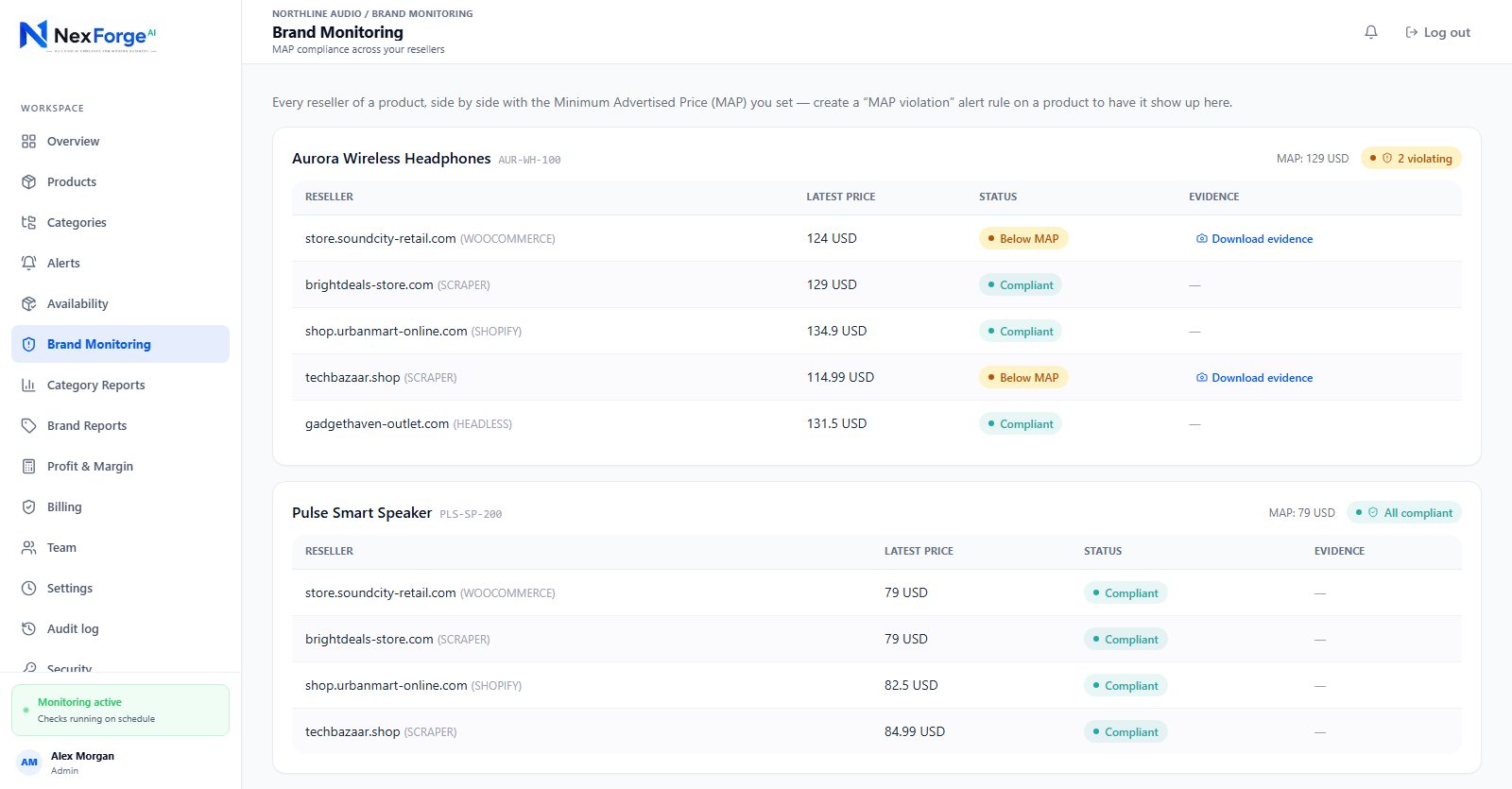
The moment a MAP violation rule fires, MarketPulse captures a full-page screenshot of the reseller’s listing at that exact time and attaches it to the alert — a downloadable, dated record for the conversation with that reseller or distributor, not just a price number you have to re-verify by hand later.
MAP activity folded into your AI-written narrative
The same AI-written pricing narrative on your dashboard summarizes MAP violations alongside price and stock activity for the week, in plain language — one paragraph that tells you whether violations are trending up before you have to dig through the alert log yourself.
Ongoing visibility, not a one-time check
A reseller’s listing is checked on the schedule you set, so a violation is caught within hours, not discovered by chance weeks later.
Works across marketplaces and storefronts
Track resellers on Shopify, WooCommerce, Amazon, eBay, Daraz, or any other public product page — the same tracking engine used everywhere else on MarketPulse.
See where and how your brand is being resold
Ongoing visibility into every channel you don’t directly control, in one dashboard instead of manually checking each reseller’s site.
Know which reseller, not just that one exists
When a marketplace listing publishes it, MarketPulse captures the seller’s name alongside the price — so a violation points you straight to who to contact, not just a bare price number.
Built-in Resilience Against Website Changes
When a reseller’s site blocks a plain request, MarketPulse automatically falls back to a stealth-enabled browser session so tracking doesn’t silently stop.
Every reseller next to your MAP, at a glance
See the bigger pricing picture, not just violations
MAP monitoring tells you when a reseller crosses a line. Market Position Reporting tells you where your whole catalog sits against the market — including those same resellers — as one report with an AI-written narrative, not a spreadsheet you rebuild by hand.
Market position & reporting
A live Price Index and category breakdowns showing above/at/below tracked competitors and resellers.
Learn moreCompetitor price tracking
The same tracking engine that watches resellers for MAP also tracks direct competitors’ prices, stock and reviews.
Learn moreFrequently asked questions
What is MAP monitoring?
Minimum Advertised Price (MAP) monitoring means tracking whether resellers advertise your product below a price floor you’ve set, so you can catch and address violations before they erode trust in your brand.
Do I need a separate MAP monitoring tool?
No — MarketPulse isn’t a separate MAP monitoring tool. It’s the same competitor-link tracking and alerting engine already used for direct competitor monitoring, applied to a reseller’s listing instead.
How quickly will I know about a violation?
As soon as MarketPulse’s next scheduled check on that link runs — from every 15 minutes on faster plans to a few times a day, whichever you’ve set.
Can I monitor resellers on marketplaces, not just their own site?
Yes — the same tracking engine covers marketplace listings (Amazon, eBay, Daraz and others) as well as independent storefronts.
Can I tell which specific reseller is violating MAP?
When the marketplace listing publishes a seller name in its own page data, MarketPulse captures it alongside the price — not guaranteed on every listing, but there when the site provides it.
Is MarketPulse the best map monitoring software for brands?
MarketPulse aims to be the best map monitoring software for brands by applying the same multi-layered competitor tracking infrastructure to reseller listings. Instead of managing disparate tools, you receive real-time price validation, instant alerts, and automated proof dashboards under one single ecosystem to protect your margins without extra software costs.
What are the best map violation monitoring tools for multiple marketplaces?
When comparing the best map violation monitoring tools for multiple marketplaces, broad cross-platform coverage is essential. MarketPulse addresses this by tracking Shopify, WooCommerce, Amazon, eBay, and Daraz using a single, unified pipeline. Our automated browser-based rendering ensures your pricing thresholds remain completely resilient even on strict retail channels.
How does AI enhance MAP monitoring?
MarketPulse doesn’t use AI to detect a violation — that’s a plain threshold check, which is more reliable than a probabilistic guess. What AI does add is the weekly narrative on your dashboard: it folds MAP violation counts in alongside price drops, stock-outs and repricing activity into one plain-language paragraph, so you get the trend without reading the raw alert log yourself.
What are the benefits of using MAP monitoring software?
Catching a violation in hours instead of weeks, before it drags down how the market perceives your brand or trains customers to wait for a discount. A timestamped screenshot for every violation gives you evidence for the conversation with that reseller instead of a disputed price number. And running on the same engine as your competitor tracking means no second tool, no second login, no second bill.
How can I analyze my market position with MAP monitoring?
MAP monitoring and Market Position Reporting share the same underlying tracked links, so a reseller you’re watching for MAP violations also counts toward where your catalog sits against the market — see Market Position Reporting for the live Price Index and category breakdowns built from that same data.