
Automated Competitor Price Tracking & Monitoring Platform
MarketPulse’s competitor price tracking watches unlimited competitor prices, stock and reviews automatically — one dashboard, no spreadsheets, no manual price-checking.
Under the hood, that means checking the same products across every competitor you name on a schedule, keeping a full price and stock history instead of just today’s snapshot, and converting a competitor’s price into your own currency when they sell in a different one. That history feeds straight into market position analysis — where your whole catalog sits against tracked competitors — an AI-written narrative that explains the trend in plain language, and repricing rules bounded by your own price floor, so tracking turns into a pricing strategy instead of a spreadsheet nobody has time to read.
14-day free trial · No card required
Every competitor’s price, stock and promos — next to your own price, in one place.
Why Traditional Competitor Price Tracker Tools Fail
Core Capabilities of MarketPulse Price Tracker
Track competitor pricing changes, stock and reviews on every link
Add a product once, attach every competitor URL you care about, and MarketPulse checks each one on a schedule you control — track competitor pricing changes as they happen, building a full history, not just today’s snapshot.
Accuracy Across Every Competitor Website
Reads Shopify and WooCommerce directly, calls Amazon’s own product data, and falls back to a real browser session for JavaScript-heavy sites (like Daraz) that a plain request can’t see the price on.
Seller name, shipping cost & delivery time
Captured whenever a competitor’s page publishes it — see which reseller is behind a marketplace listing, and how their shipping compares to yours, not just the sticker price.
Your own custom fields
Define a CSS selector for anything else a competitor’s page shows — pack size, a cart-only discount, a shelf price — and MarketPulse extracts it on the same schedule as price and stock.
Barcode-based Product Matching
Auto-discover a competitor’s listing for a product instead of pasting URLs by hand, one at a time.
Multi-market and multi-currency tracking
Track a competitor who prices in a different currency than you do — recorded competitor prices convert automatically to your own display currency, so comparisons across markets stay accurate without doing the conversion by hand.
An AI-written pricing narrative
A plain-language paragraph explaining your pricing trend based on what you track — not just another number, an actual generated summary you can read on your dashboard.
CSV import/export for bulk setup
Bring your whole catalog and its competitor links in at once instead of adding products one by one.
Checked on your schedule
From every 15 minutes on faster plans to a few times a day — instead of refreshing competitor pages by hand.
A Failing Competitor Feed is Visible Immediately
Every competitor link shows its last successful check and any consecutive failures right on the Products page, so you find out the moment tracking breaks, not weeks later.
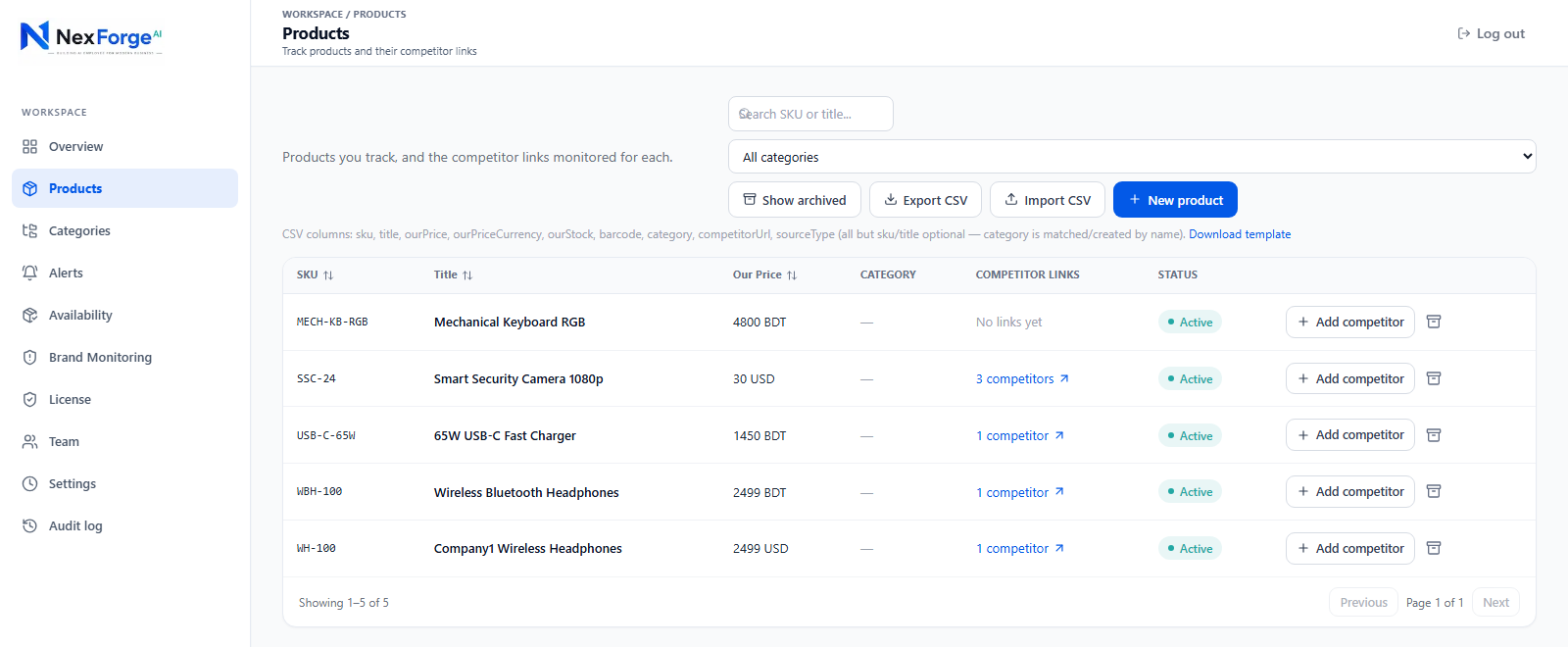
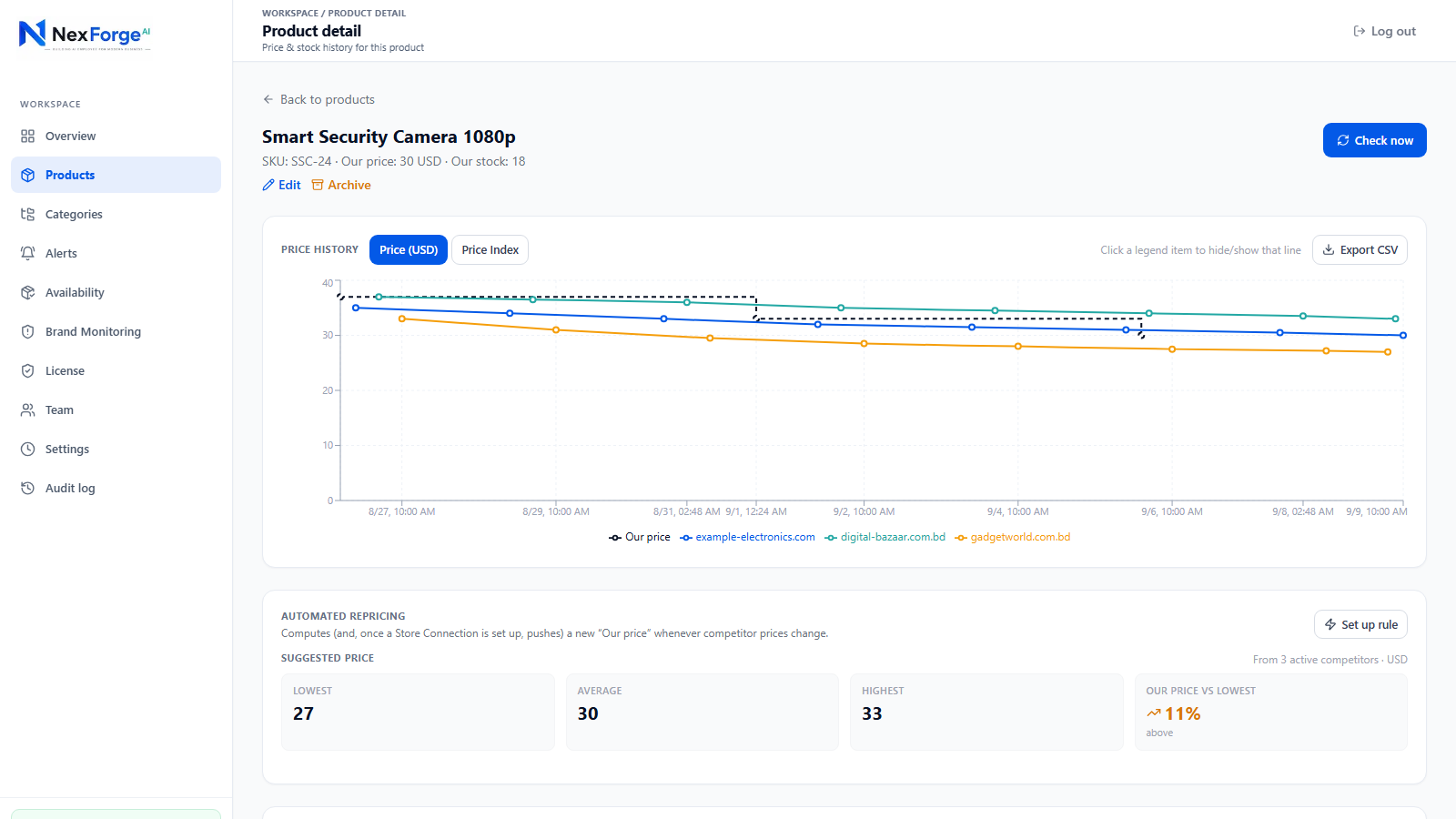
A single tracked product’s full price and competitor history — not just today’s snapshot.
Turn Ecommerce Competitor Price Monitoring into Automated Strategy
Tracking is the input; these are the three ways MarketPulse turns it into a pricing strategy instead of a read-only feed — reprice automatically against what you track, hear about changes the moment they happen, and see how your whole catalog stacks up against the market you’re tracking.
Automated repricing
Match the lowest tracked competitor, beat them by a percentage, or hold your ceiling — every rule is bounded by a hard price floor it can never cross.
Learn moreMarket position & reporting
See where your whole catalog sits against the market — above, at, or below tracked competitors — plus an AI-written narrative explaining the trend, not just a spreadsheet you rebuild by hand.
Learn moreFrequently asked questions
What does competitor price tracking mean?
An automated way to keep watch on what competitors charge for the same or similar products. Implementing a digital competitor price tracking workflow ensures your retail pricing decisions are always based on real-time market shifts instead of outdated assumptions or manual guesswork.
Can I track unlimited competitors with this software?
Yes. How many competitor links you can monitor simultaneously depends entirely on your active plan tier, not on any fixed per-competitor limits. This allows you to scale your market awareness seamlessly as your store portfolio grows.
What marketplaces and e-commerce platforms are supported?
Shopify and WooCommerce stores connect directly via native API access; channels like Amazon, eBay, and Daraz are supported through dedicated tracking pipelines. Additionally, virtually any public, independent merchant product page can be fully integrated into your monitoring layout.
What happens if a competitor site blocks automated plain requests?
MarketPulse automatically deploys a fallback to a stealth-enabled browser session for complex retail sites that restrict basic server calls. To eliminate guesswork, any ongoing connectivity status or failure is updated instantly on your core Products page so it never breaks silently.
Does MarketPulse track metrics besides product price, stock, and reviews?
Yes. The platform captures vital data including merchant names, dynamic shipping costs, and projected delivery times whenever a competitors page publishes them. You can also map out any custom data point—like bundle pack sizes or cart-only discounts—using our adaptive CSS selectors.
How is this different from a manual competitor price tracker?
A manual competitor price tracker setup forces your team to check links one by one and manually log numbers into static files. MarketPulse replaces this friction by digitizing the entire scope of ecommerce competitor price monitoring, delivering automated scheduled checks, unified history metrics, and immediate movement pings.
How do I track competitor pricing changes online over time?
Instead of viewing an isolated daily snapshot, our infrastructure preserves the complete historical trend for every connected merchant. To effectively track competitor pricing changes online, the system feeds this continuous dataset straight into unified market position analytics and dynamic price guardrails automatically.
What criteria should I prioritize in competitor pricing software?
You should look for high data precision across modern JavaScript-rendered stores, immediate visibility into your connection diagnostics, historical charting capabilities, and an automated layer (such as repricing rules or alert digests) to act on market movements instantly without manual recalculations.
How accurate and dependable is the competitor pricing data?
MarketPulse pulls directly from store APIs where available and deploys fully managed browser-based tasks for complex frontend layers. Every diagnostic failure updates your operational log immediately rather than generating silent anomalies, making sure your data streams remain highly visible and fully transparent.
Why should you be careful about monitoring competitors?
Track publicly published pricing pages, respect the rate limits and terms of the sites you check, and avoid hammering a competitor’s site with requests — that’s why MarketPulse checks on a schedule you control rather than continuously, and automatically backs off to a slower, stealth-enabled method for sites that need it instead of retrying aggressively.
Is tracking competitor pricing compliant with industry standards?
Yes, because MarketPulse strictly monitors publicly accessible pricing endpoints, maintains deep respect for target rate configurations, and operates on controlled cycles to prevent server overhead. The engine scales down aggressively using non-intrusive paths for strict architectures rather than repeating high-velocity loops.